Pause Ad Measurement: Understand the Value of Every Placement
Evaluate pause ads through delivery, viewer response, and net revenue, with a clear view of the viewing experience.
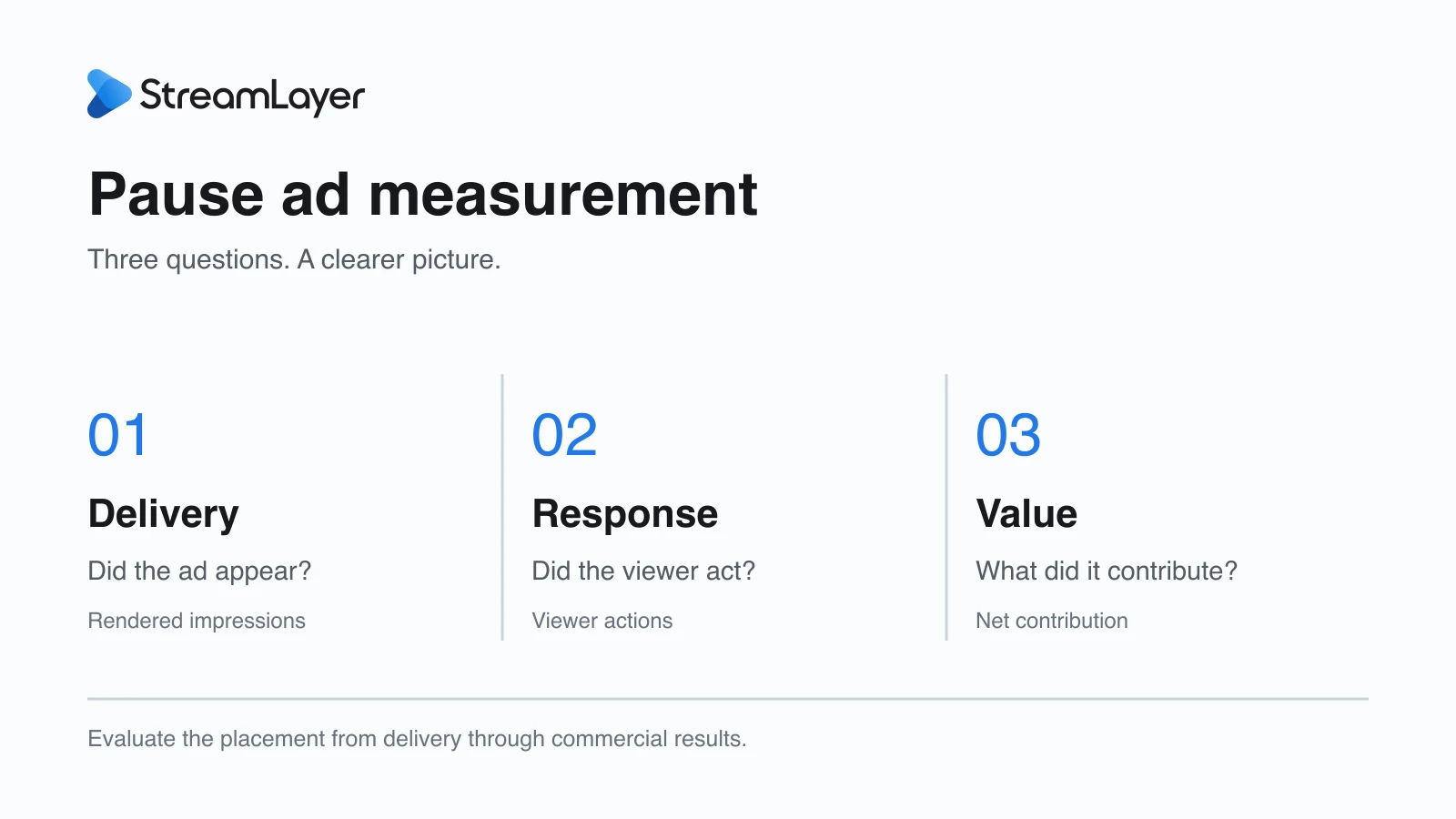
Pause ads create an advertising opportunity when a viewer chooses to stop playback. For an OTT product owner, the next question is what that opportunity is worth: how often an ad reaches the screen, whether viewers respond, and what the placement contributes to the business.
A useful evaluation connects those three questions. With StreamLayer Pause Ads, your team can plan a pilot around a defined audience, creative format, and commercial offer, then use the results to decide what to expand.
Start with what reached the screen
An eligible pause is the starting point. It becomes a delivered impression only when the ad actually appears under your agreed measurement rules. A viewer may resume before the creative arrives, an ad request may return no fill, or an asset may fail to load.
Follow the opportunity through a few clear stages:
- Eligible pauses: Sessions that meet your content, device, timing, and frequency rules.
- Ad requests: Requests made for those opportunities, counted under a defined request policy.
- Ready creative: Valid assets loaded while the viewer is still paused.
- Rendered impressions: Ads displayed on the viewer's screen.
- Exposure duration: Time on screen before resume, close, or an app-state change ends the placement.
These stages help your team locate the next improvement. If many viewers resume before an ad appears, review the pause delay and creative readiness. If delivery works but requests often receive no ad, review the supply and demand path with your advertising partners.
Understand what viewers chose to do
A pause ad can invite viewers to explore an offer, scan a QR code, select a product, or send an offer to their phone. Measure each action separately so you can see which experience is useful.
Define both the action and its denominator. A QR scan rate, for example, can mean unique scans divided by rendered impressions. Report unique and total actions separately, and account for viewers who use more than one interaction in the same session.
Visits, leads, and purchases add another layer. Connect destination tracking and agree on consent and attribution rules before treating them as campaign outcomes. A scan records interest; a completed purchase requires its own evidence. Brand recall and attention also need an appropriate study beyond delivery logs.
Turn delivery into a commercial picture
For campaigns priced per thousand impressions, or CPM, revenue depends on billable delivery and the price actually achieved. A simple planning model is:
Estimated billable impressions = eligible pauses × render rate × billable share of renders.
Gross media revenue = billable impressions ÷ 1,000 × realized CPM.
Here, render rate means rendered ads divided by eligible pauses. It already reflects no fill, early resumes, and delivery failures, so a separate fill-rate multiplier would count those losses twice.
As an illustration, 100,000 eligible pauses with a 60% render rate and a 100% billable share would produce 60,000 billable impressions. At an assumed $20 CPM, that would generate $1,200 in gross media revenue. These are hypothetical inputs for explaining the calculation, not StreamLayer results or market benchmarks.
Then apply your actual supply fees, platform charges, creative costs, and operating costs. Net contribution gives your team a more useful basis for deciding whether to expand the placement.
Keep the viewing experience in the scorecard
The ad should close when the viewer resumes, restore any resized player layout, and preserve normal remote navigation. Review those behaviors alongside playback errors, session exits, and viewer feedback.
Compare the pilot with an agreed baseline. Where practical, use a comparable group without the placement to help distinguish its effect from changes in audience or programming. Keep device mix and campaign conditions comparable, and identify observational comparisons as such.
The same discipline applies to revenue. A pause campaign can generate sales while also drawing budget from another placement. Account for that movement when assessing how much revenue is incremental.
Use the pilot to make the next decision
Before launch, your product, advertising, and engineering teams should agree on the audience, placement rules, creative, measurement definitions, and criteria for expansion. Reconcile app-side delivery with the ad server and supply reports so everyone is evaluating the same campaign.
The final report should connect the operating conditions to the outcomes: what ran, who could see it, what reached the screen, what viewers did, and what the publisher earned after costs. Include the baseline and known measurement limits.
That gives you a practical choice: refine creative, improve delivery, adjust eligibility, or extend a successful placement to more of your audience.
Explore StreamLayer Pause Ads, review programmatic delivery, or discuss a pilot for your app.