Programmatic Pause Ads: From Viewer Pause to Advertiser Opportunity
Understand how StreamLayer connects pause experiences in your app with the advertising systems and buying paths around them.
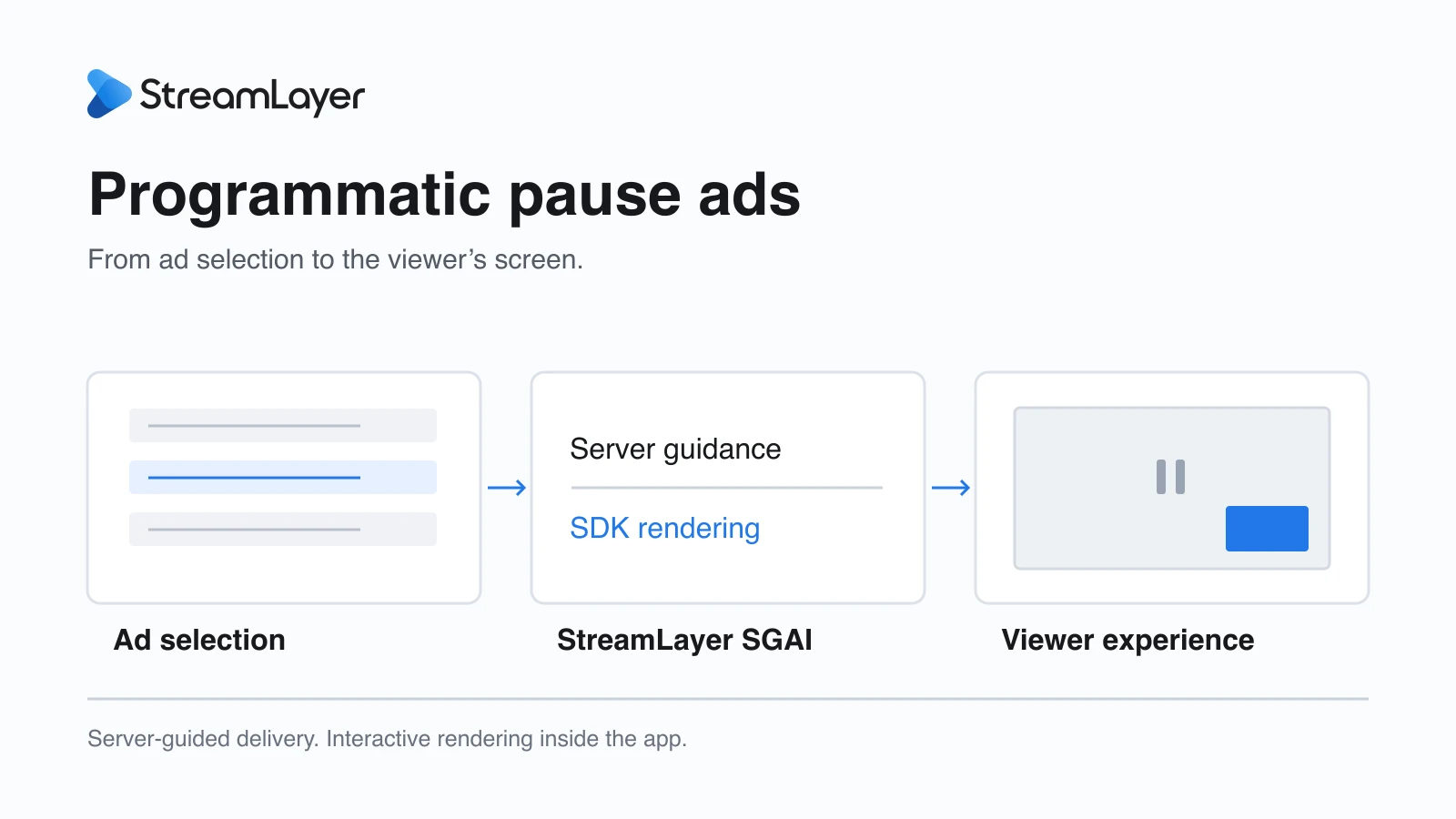
When a viewer pauses, your app has a new opportunity to present an advertiser's message. Programmatic delivery connects that opportunity to an agreed buying path, so an eligible advertiser can reach the viewer during the pause.
StreamLayer provides the pause experience inside your streaming app. Your advertising partners handle their parts of selection and buying, while your team controls the placement, audience eligibility, and viewing experience.
Begin with the viewer
A viewer pauses a program. After the configured delay, an eligible ad appears as a full-screen creative, a compact overlay, or a placement beside the paused picture. It can offer a product, useful information, or an action the viewer can take with a remote or phone.
StreamLayer Pause Ads use still imagery or subtle, silent ambient motion. The scene continues to feel paused. When the viewer resumes playback, the pause ad closes.
Programmatic buying happens behind that experience. The viewer sees the selected creative; the publisher's app and advertising systems coordinate whether an ad is available and how it reaches the screen.
Give each part of the workflow a clear role
Your app, StreamLayer, and your advertising partners work together:
- Your platform controls pause behavior, placement eligibility, frequency, screen layout, and the inventory offered to advertisers.
- StreamLayer uses StreamLayer SGAI and its software development kit, or SDK, to coordinate and display interactive pause experiences inside the app.
- Your ad server and supply partners handle the selection and delivery responsibilities defined for the integration.
- The supply-side platform, or SSP, connects eligible inventory to buyers and runs an auction where the buying arrangement calls for one.
- The advertiser and demand-side platform, or DSP, define campaign criteria, bids, and approved creative.
The exact request sequence depends on your setup. Agree on which system requests the ad, returns the creative, and records each event before launching the placement.
Choose how the inventory will be sold
A direct-sold sponsorship starts with an agreement between the publisher and advertiser. A private marketplace makes an agreed inventory package available to selected programmatic buyers. Other programmatic arrangements depend on the connections supported by your supply and buying partners.
The product decision is the package you want to offer: which content and audience it reaches, how the ad appears, and which viewer actions it supports. Your commercial team can then define the buying route, pricing, and delivery commitment around that package.
General CTV buying access does not establish that a particular pause format is available. Confirm the actual publisher, device coverage, creative requirements, and transaction path with the partners involved.
Connect the placement to your app
Your engineering team integrates the StreamLayer SDK and connects pause and resume signals. Your app provides the area where the ad appears and controls any video resizing for a Side Bar or L-Bar layout.
This work happens in the application the viewer uses. If your content is distributed through another company's app, that operator needs to participate in enabling the placement. Changing a channel's video feed alone does not add the StreamLayer experience to a third-party app.
Plan the integration around your audience's devices, starting with CTV, followed by mobile and web. The launch scope should connect the chosen creative, input controls, and buying path to those devices.
Make the offer clear to buyers
Give advertisers a concise description of the inventory: the publishers and apps included, the audience and markets, the pause layout, and the available interactions. Add the required creative assets, buying route, and measurement definitions.
Available campaign reach depends on the eligible audience and the inventory included in that deal. StreamLayer's overall deployment footprint is a different measure. A buyer needs the reach and delivery terms for the package being purchased.
For creative preparation, use the pause ad examples and specifications. For partner discussions, the CTV pause ad standards overview identifies the signaling and format questions to resolve.
Prove the complete experience
Test from the viewer's pause through ad display, interaction, and resume. Include early resumes, unavailable creative, and no-fill responses. An ad that arrives after playback has restarted should not appear.
Then reconcile rendered impressions with your ad server and supply reports. Keep remote interactions, QR scans, and downstream purchases distinct so the campaign tells a clear story about delivery and response.
A defined pilot gives your team a practical starting point: one inventory package, an agreed buying path, and a viewer experience you can evaluate before expanding.
Explore StreamLayer Pause Ads, review measurement and revenue, or talk with us about your platform.