Double Box Ads for Live Sports Streaming
How double box ads, also called split-screen or side-by-side ads, keep live sports on screen during the break, and how streaming apps deliver them.
A double box ad divides the screen into two boxes: the live program plays in one, and the commercial plays in the other. Double box ads are also called split-screen ads or side-by-side ads. The viewer keeps following the game during the break, which makes the format a natural fit for live sports.
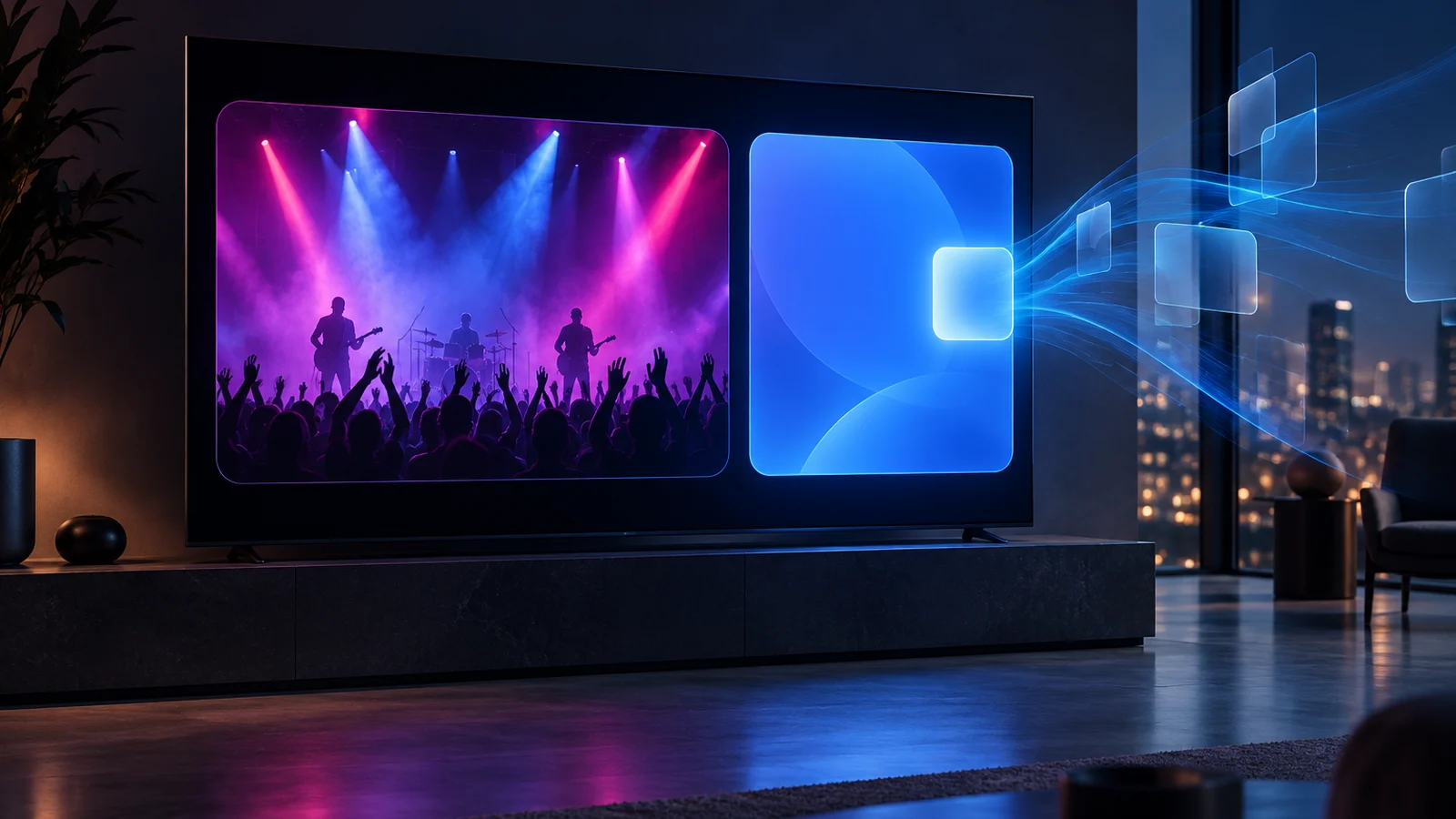
What is a double box ad, and where did it come from?
A double box ad is a broadcast ad break in which the program does not leave the screen. The program and the ad each get their own box, shown at the same time.
The format began in motorsport. According to Wikipedia's entry on side-by-side graphics, TBS first used it during a NASCAR Cup Series race in 2000. The same entry notes that Fox experimented with a split-screen commercial format it called the "Double Box" during coverage of the 2013 Cotton Bowl Classic. Other broadcast brand names include "NASCAR Non-Stop" and "Playing Through."
In the classic broadcast version, the live event plays without audio and the commercial plays with full audio. The commercial box is typically the larger of the two. The split does not have to be exactly even, but both boxes carry real weight on screen.
In search and in trade coverage, the same format appears as "split-screen ads," "side-by-side ads" and "split-screen commercials." This page uses the name Double Box throughout.
Why do double box ads suit live sports?
In live sports, a traditional break can cost the viewer a play. A double box keeps the program running, so the break no longer competes with the action.
Recent examples show the format moving into premium sports. They are cited here only as public examples of the format.
- NFL RedZone, 2025 season. Sportico reported that RedZone would run commercials in a side-by-side box while football stayed on screen. The NFL had tested four ads on one Sunday the previous December, with audio running for roughly 10 to 15 seconds. The league said the number of spots would remain limited.
- ITV, 2026 Men's Six Nations. ITV explained that split-screen ads would appear twice per match. Each lasted 20 seconds and filled the right-hand side of the screen, while live pictures continued on the left. The ITV Sport production team chose the timing, such as a break in play just before a scrum.
- NASCAR on Fox and FS1. Jayski reported in 2025 that NASCAR races on FS1 were expected to see a significant increase in side-by-side breaks.
Because the program continues, a double box is a nonlinear ad. It adds inventory inside live play without interrupting it.
How does a double box ad work in a streaming app?
In a streaming app, the program and the ad can be separate elements on the device. The host app places the live video in one box, and an SDK renders the ad in the other.
StreamLayer delivers this format as the Side-by-Side ad unit in Moment Ads, built on StreamLayer SGAI. The flow works as follows.
- A trigger fires. It can come from publisher rules and live data through the Trigger Engine, or from a manual activation in StreamLayer Studio or an API-connected control-room workflow.
- StreamLayer's server services make the decision and select the creative for that viewer.
- The host app, which controls the player layout, moves the live video into its box.
- The StreamLayer SDK renders the ad creative in the second box.
- A closing rule ends the unit, and the host app restores the full picture.
Nothing is stitched into the stream, and the live video is not modified. StreamLayer SGAI works alongside the publisher's existing SSAI, CSAI, ad server and player; it does not replace them.
The alternative is to composite the double box into the program feed, as broadcast control rooms do. That approach needs nothing on the device, but every viewer receives the same ad. With server-side decisioning and client-side rendering, each viewer can in principle see a different creative, offer or CTA.
How is a double box different from a squeezeback?
Both formats resize the program, but they use the screen differently. A squeezeback frames the video with ad space; a double box sets two boxes next to each other.
In a squeezeback, the video shrinks to open an L-bar, side-bar or frame around it. That space carries a display or interactive unit, such as a sponsor message, live stats or a QR code. The program remains the main picture.
In a double box, the screen is split into two separate boxes. One holds the program and the other holds the ad, which is often a video commercial. The two boxes share the screen, and in broadcast practice the ad box is often the larger one.
An overlay is different again: the creative sits on top of the full-size video, and nothing is resized.
Can a double box ad be interactive and use live data?
Yes. When the ad box is rendered by an SDK rather than burned into the feed, it can respond to the viewer and to the game.
Moment Ads support CTA buttons, QR codes, send-to-phone, polls, trivia, commerce and dynamic creative. They can also show live data such as scores, stats and live odds. On a TV, a QR code or send-to-phone option lets the viewer act without leaving the game.
Moment Intelligence identifies advertising opportunities from live game context and live data. An identified moment does not automatically trigger an ad; publisher rules decide which moments become double box breaks.
For breaks that are already stitched by an SSAI provider, Interactive SSAI adds a synchronized interactive layer to the stitched ad instead.
What controls should publishers set for double box ads?
A double box shrinks the picture and divides attention, so it needs clear rules. In StreamLayer Studio, publishers control eligibility, timing, pacing, placement and closing.
- Timing. Run units at stoppages and lulls, not during decisive play.
- Frequency. Keep the count low and predictable across a match.
- Audio. Decide whether the viewer hears program audio, ad audio or a mix. The player belongs to the host app, so the audio policy stays with the publisher.
- Closing rules. End the unit immediately if play restarts or a key moment begins.
- Screen size. Two boxes work well on a TV but are small on a phone. Consider a squeezeback or a Picture-in-Picture unit on mobile.
Moment Ads run on the platforms the StreamLayer SDK supports, including iOS, Android, Web, tvOS, Android TV, Roku, Samsung Tizen and LG webOS. For timing strategy, see our guide to key moment advertising in live sports.
Frequently asked questions
Are double box ads the same as split-screen ads?
Yes. Double box, split-screen and side-by-side are names for the same format. The program plays in one box and the ad plays in the other, at the same time.
Is a double box ad linear or nonlinear?
It is nonlinear, because the program keeps playing while the ad is on screen. A linear ad replaces the program for the length of the break.
Is a double box the same as picture-in-picture?
No. A double box gives the program and the ad separate boxes that share the screen. Picture-in-picture places one of them in a small inset window over the other. Moment Ads offer both as separate units.
Does a double box ad require stitching the ad into the stream?
Not with StreamLayer SGAI. The decision is made server-side, and the SDK renders the ad in the app, so nothing is stitched and the live video is not modified. Broadcasters can also composite a double box into the feed, but then every viewer sees the same ad.
For the full set of formats, see nonlinear ads for streaming. To plan double box units for your live sports streams, talk to StreamLayer.